Updated on July 9, 2026
Quick summary: having a whistleblowing channel is not only about complying with a legal obligation. When properly structured, it helps a company detect fraud, reduce losses, prevent harassment, demonstrate diligence, strengthen its internal culture and improve its position in dealings with clients, investors and public authorities.
The main legal basis includes Law No. 14,457/2022, which requires procedures for receiving and following up on reports for companies with a CIPA; NR-01, which included psychosocial risk factors in Occupational Risk Management; the Brazilian Anti-Corruption Law, which considers integrity programs in the calculation of sanctions; and the LGPD, which requires care in the processing of personal data received through the channel.
International data also reinforces the practical importance of the topic: according to the Association of Certified Fraud Examiners (ACFE), tips remain the main method for detecting occupational fraud worldwide, representing 43% of the cases analyzed in the 2026 report.
Why discuss the benefits of a whistleblowing channel?
When people talk about a whistleblowing channel, the first association is usually legal compliance. That makes sense: Law No. 14,457/2022 made it mandatory, for companies with a CIPA (Internal Commission for the Prevention of Accidents and Harassment), to establish procedures for receiving and following up on reports, with guaranteed anonymity for the reporting person.
The update to NR-01 also reinforced the importance of internal listening mechanisms, because psychosocial risk factors related to work became part of GRO (Occupational Risk Management) and PGR (Risk Management Program). But treating the channel only as a compliance item is seeing only half of the story.
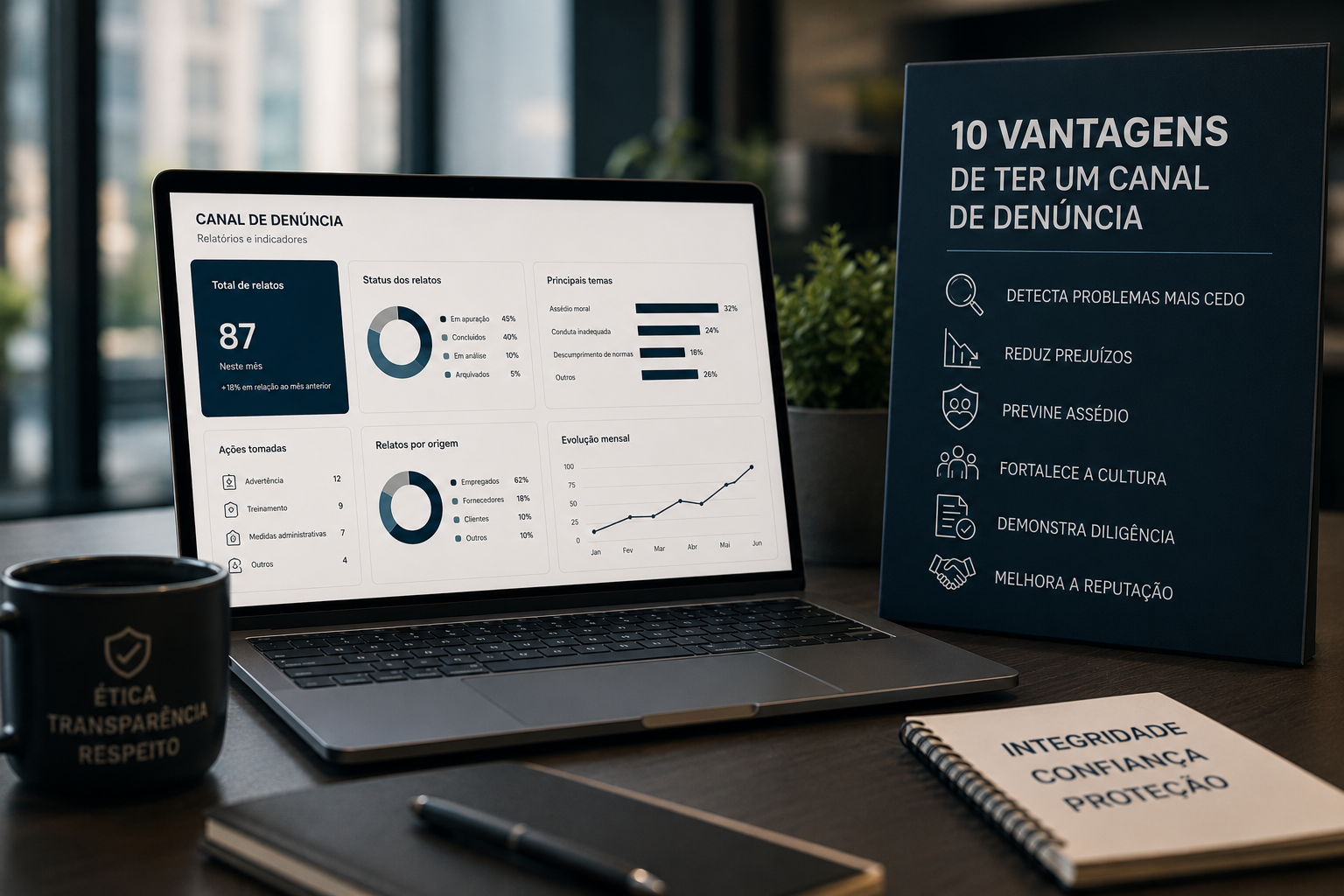
Companies that maintain effective whistleblowing channels obtain concrete benefits: they identify problems earlier, reduce losses, strengthen internal culture, demonstrate good faith and reduce the chance that an internal issue becomes a lawsuit, inspection or reputational crisis. In this article, we bring together 10 benefits of a whistleblowing channel, with legal basis, data and practical explanations.
Summary of the 10 benefits
In direct terms, a whistleblowing channel can help a company to:
- discover fraud earlier;
- reduce the size of losses;
- demonstrate diligence in labor claims;
- strengthen the integrity program;
- handle problems internally before they become crises;
- support the PGR and psychosocial risk management;
- reduce risks of absences and turnover;
- gain points with clients, public tenders and investors;
- strengthen culture and internal trust;
- demonstrate good faith and management commitment.
1. Discover fraud earlier
The Association of Certified Fraud Examiners (ACFE), one of the leading anti-fraud organizations in the world, periodically publishes the Report to the Nations, based on real occupational fraud cases. The 2026 edition analyzed 2,402 real cases in 143 countries and territories and confirms a pattern observed for years: tips remain the main method of fraud detection in organizations.
According to the ACFE, tips were responsible for 43% of detected cases. No other single method achieved a similar result. In practice, the whistleblowing channel is one of the most important tools for discovering internal fraud, misconduct and irregularities before the damage becomes greater.
Another relevant point is the source of reports: more than half usually come from employees themselves, but clients, suppliers and third parties can also be important sources of information. For this reason, the channel should not be seen only as an HR tool. It is also a tool for management, audit, governance and asset protection.
2. Reduce the size of losses
Fraud usually causes losses not only because of the act itself, but because of the length of time it remains hidden. The longer a fraudulent scheme lasts, the greater the loss tends to be. The whistleblowing channel acts precisely on this variable: detection time.
When the company offers a safe path for employees, clients, suppliers or third parties to report irregularities, it increases the chance of discovering the problem earlier. According to ACFE analyses, organizations with formal reporting mechanisms tend to detect fraud more quickly and suffer lower losses than organizations without structured channels.
This does not mean that the channel completely eliminates fraud risk, because no tool does that alone. But it means that the channel helps the company move from late discovery to early warning, before the problem becomes a financial, legal or reputational crisis.
3. Serve as evidence of diligence in labor claims
In a labor claim involving moral harassment, sexual harassment, discrimination, psychological violence or corporate omission, one of the central questions is: what did the company do to prevent, receive, investigate and address the problem?
A company that has a structured whistleblowing channel, a disclosed internal policy, periodic training and a documented investigation flow can demonstrate that it adopted concrete prevention and response measures. This does not automatically prevent a judgment against the company, because each case depends on the evidence and the company’s conduct, but it helps demonstrate diligence.
Diligence, in this context, means showing that the company did not remain inactive: it created a mechanism to receive reports, investigated the facts, recorded measures and adopted proportional actions when necessary. On the other hand, a company that has no channel, does not train leaders and does not record measures tends to be in a weaker position, and in serious cases this omission may weigh in the analysis of the employer’s liability.
4. Strengthen an integrity program that may reduce sanctions under the Anti-Corruption Law
This is a very important benefit, especially for companies that sell to the government, participate in public tenders, deal with public officials or operate in the supply chains of large companies. Law No. 12,846/2013, known as the Brazilian Anti-Corruption Law, provides for the strict liability of legal entities for harmful acts against the public administration.
Decree No. 11,129/2022, which regulates the Anti-Corruption Law, establishes criteria for evaluating integrity programs. Among these criteria is the existence of channels for reporting irregularities, open and widely disclosed to employees and third parties, with mechanisms for handling reports and protecting good-faith whistleblowers.
It is important to make a distinction: the whistleblowing channel, by itself, does not automatically reduce a fine. What may be considered in the calculation of the sanction is the existence and application of an effective integrity program, of which the channel is one of the relevant pieces. When properly implemented, disclosed and accompanied by a real handling flow, the channel helps demonstrate that the company has internal mechanisms to prevent, detect and respond to irregularities, which can make a difference in administrative proceedings, audits and third-party due diligence.
5. Resolve the problem in-house before it leaves the company
Every internal problem has two possible destinations: it can be handled by the company or by third parties. When an employee does not find a reliable internal path, the tendency is to seek help outside the company, and the report may reach the Labor Court, the Labor Prosecutor’s Office, labor inspection authorities, the press, social media or public complaint platforms.
The whistleblowing channel works as an early warning system: it allows the company to become aware of the problem before the situation escalates. This does not mean hiding irregularities, but handling them correctly. When the company receives a report, investigates it seriously, protects those involved and adopts proportional measures, it reduces the chance that the problem will become a larger crisis. This is one of the greatest practical values of the channel: allowing the company to correct course before third parties do it for the company.
Want to implement a whistleblowing channel with anonymity, a tracking protocol and case management? Denuncie Aqui helps your company structure this process in a simple, safe and accessible way.
6. Support the PGR and psychosocial risk management under NR-01
Since May 26, 2026, the new wording of NR-01 has included psychosocial risk factors related to work in GRO and PGR. These factors may involve situations such as harassment, overload, abusive targets, excessive pressure, internal conflicts, lack of leadership support and other conditions that affect workers’ mental health.
It is important to remember that, on June 25, 2026, the STF (Brazilian Supreme Federal Court) temporarily suspended, for 90 days, the application of fines and administrative sanctions specifically related to the NR-01 provisions on psychosocial risks. That decision did not revoke the standard: NR-01 remains in force, and the topic continues to be relevant for occupational health and safety management, for the Labor Prosecutor’s Office and for the analysis of liability in labor claims.
In this context, the whistleblowing channel has an important role in psychosocial risk management under NR-01. Reports received can reveal, with real data, where the sources of harassment, overload, abuse of power, conflicts and management failures are located. Aggregated reports from the channel help the company to:
- identify critical departments;
- target training;
- review targets and leadership practices;
- update the PGR;
- demonstrate that risk management exists in practice, not only on paper.
The channel does not replace the PGR or the technical risk assessment, but it can be a valuable source of information for psychosocial risk management.
7. Reduce risks of absences and turnover
Mental health at work has become a central concern for companies, public authorities and workers. In 2025, Brazilian Social Security granted 546,254 temporary disability benefits for mental and behavioral disorders, a 15.66% increase compared with 2024, when 472,328 benefits of this nature were granted.
This number shows that the topic is no longer abstract. Work environments where harassment, overload, humiliation and conflicts are not heard tend to make people ill, and people who become ill take leave, lose productivity or resign. The whistleblowing channel, when combined with serious investigation and preventive measures, helps interrupt this cycle earlier, allowing the company to identify warning signs before the problem results in absence, litigation or loss of talent.
Of course, the channel alone does not solve every mental health problem. But it is an important tool within a broader strategy, which should involve leadership, working-hours management, review of targets, harassment prevention, internal communication and monitoring of psychosocial risks.
8. Gain points with large clients, public tenders and investors
The whistleblowing channel can also generate a competitive advantage. Large companies, financial institutions, investors and public contractors are increasingly attentive to integrity, governance and risk management criteria. Law No. 14,133/2021, known as the New Public Procurement Law, provides for the requirement of an integrity program in large-value public contracts.
In addition, larger private companies often conduct supplier approval processes and integrity due diligence. In these processes, they commonly ask whether the company has:
- a code of conduct;
- a whistleblowing channel;
- an anti-corruption policy;
- harassment prevention measures;
- internal controls;
- investigation procedures;
- protection against retaliation.
Companies that have these elements tend to respond better to supplier approval processes, supplier audits and requirements from large contractors. This may not automatically guarantee a contract, but it may prevent the company from being eliminated due to lack of minimum governance structure. For companies that want to grow, sell to large clients or participate in relevant public tenders, the channel is no longer only an obligation. It becomes part of the commercial strategy.
9. Strengthen culture and internal trust
There is a less visible but very important effect: the whistleblowing channel sends a message. It shows employees that the company takes ethics, respect and safety seriously. When the channel is well disclosed, protected against retaliation and supported by serious investigation, it helps strengthen internal trust, and workers know that there is a path to report problems without having to expose themselves directly. This improves the organizational climate and contributes to talent retention.
The opposite is also true. When the company ignores reports, protects offenders or treats reports as an inconvenience, the culture deteriorates. Over time, good professionals leave, candidates research negative reviews and the employer brand is harmed. For this reason, the whistleblowing channel is not only a legal tool. It is also a tool for organizational culture.
10. Demonstrate good faith and management commitment
Finally, there is institutional value. Before bodies such as the Labor Court, the Labor Prosecutor’s Office, the Ministry of Labor and Employment, the Office of the Comptroller General, clients, employees or the press, a company that maintains an effective whistleblowing channel demonstrates good faith. It shows that it created a mechanism to be informed about its own problems and committed itself to addressing them.
This posture changes the narrative in moments of crisis. One thing is for a company to be surprised by an irregularity without any mechanism for prevention, listening or response; that image is one of negligence. Another is to demonstrate that the company received a report, investigated it, documented it and corrected the failure; that image is one of diligence. This does not eliminate liability when there has been a failure, but it shows that management adopted concrete measures to prevent, detect and correct problems. In increasingly regulated and exposed environments, this difference matters.
Frequently asked questions about the benefits of a whistleblowing channel
Does a whistleblowing channel reduce fraud?
A whistleblowing channel does not completely eliminate fraud risk, but it helps detect irregularities earlier. According to the ACFE, tips are the main method of occupational fraud detection, representing 43% of the cases analyzed in the 2026 report. The earlier the company discovers the problem, the greater the chance of reducing losses and preventing the fraud from continuing.
Does a whistleblowing channel help in labor claims?
Yes, it can help. A structured, disclosed channel accompanied by a documented investigation flow can serve as evidence of the company’s diligence, especially in cases of moral harassment, sexual harassment, discrimination, psychological violence or corporate omission. The channel does not automatically prevent a judgment against the company, but it helps demonstrate that the company adopted prevention and response measures.
Does a whistleblowing channel reduce fines under the Anti-Corruption Law?
The channel alone does not automatically reduce a fine. But it is an important part of an effective integrity program. Decree No. 11,129/2022 considers whistleblowing channels, mechanisms for handling reports and protection for good-faith whistleblowers as parameters for evaluating the integrity program, which can contribute to demonstrating its effectiveness in administrative proceedings.
Is a whistleblowing channel useful for small companies?
Yes. Even when a small company is not required to establish a CIPA, the channel can be useful as a tool for prevention, listening, risk management and reputational protection. With more accessible digital platforms, it is no longer a solution exclusive to large companies and can be a simple way to prevent internal problems from becoming labor claims or external reports.
Does a whistleblowing channel improve psychosocial risk management?
Yes, as long as the data is used correctly. Reports about harassment, overload, conflicts, fear of retaliation or abuse of power may indicate psychosocial risk factors. This information, when treated in an aggregated and confidential manner, can support the update of the PGR and the planning of preventive actions.
Conclusion: is a whistleblowing channel a cost or an investment?
The most realistic answer is: investment. On one side, the company has an accessible monthly cost, now within reach even for small and medium-sized businesses. On the other side, it has a tool capable of supporting fraud detection, reducing losses, preventing harassment, demonstrating diligence, strengthening the integrity program, supporting psychosocial risk management and improving internal trust. Few management tools deliver so many benefits at the same time.
And, for companies with a CIPA, it is not only a choice: Law No. 14,457/2022 has required procedures for receiving and following up on reports, with guaranteed anonymity, since March 2023. If your company does not yet have a channel, the first step is to understand the legal obligation of a whistleblowing channel and then structure the implementation in a simple, safe and documented way.
The important point is not to treat the channel as a formality. An effective channel is one that the company discloses, protects, investigates, records and uses to improve its management.
Want to turn these benefits into reality in your company with a complete and accessible whistleblowing channel? Get to know the Denuncie Aqui platform.
Important note
This article is for informational purposes only and does not replace legal analysis of a specific case. The percentages, criteria for reduction of sanctions and legal effects related to integrity programs depend on the assessment of the competent authorities in each case. In addition, the existence of a whistleblowing channel does not, by itself, eliminate the company’s liability: the channel must be accompanied by an internal policy, investigation flow, protection against retaliation, adequate records and effective corrective measures.
Legal references and official sources
- Law No. 14,457/2022 — Emprega + Mulheres Program.
- Law No. 12,846/2013 — Brazilian Anti-Corruption Law.
- Decree No. 11,129/2022 — Regulates the Anti-Corruption Law and defines parameters for evaluating integrity programs.
- Law No. 14,133/2021 — Public Procurement and Administrative Contracts Law.
- NR-01 — General Provisions and Occupational Risk Management.
- Ordinance MTE No. 1,419/2024 — new wording of chapter 1.5 of NR-01.
- Ordinance MTE No. 765/2025 — effective date of the new wording of chapter 1.5 of NR-01 on May 26, 2026.
- Decision of the Brazilian Supreme Federal Court in ADPF 1316 — temporary suspension of administrative sanctions related to the NR-01 provisions on psychosocial risks.
- ACFE — Occupational Fraud 2026: A Report to the Nations.
- Brazilian Ministry of Social Security — data on temporary disability benefits for mental and behavioral disorders in 2025.